The Matching Set Is Not Always the Best Set
A considered arrangement of handmade objects need not match. Use a week-long plan to balance shape, texture and finish without losing coherence.
A matching set can make a shelf of handmade objects feel more uniform than the room around it. To arrange handmade objects with more character, keep one point of connection—perhaps a shared colour or material—and let shape, texture or finish differ elsewhere.
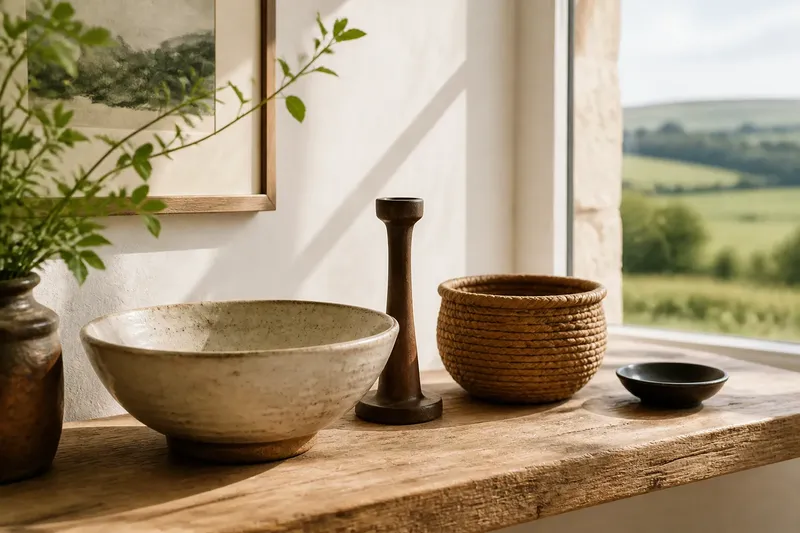
This is not a case for collecting oddities at random. A thrown stoneware bowl, a turned wooden candlestick and a small cast-metal dish can sit together if their differences have a little space and a reason. A week of small adjustments is enough to see whether the arrangement feels composed or merely crowded.
What should hold the arrangement together?
Choose a quiet link before moving anything. It might be a warm, earthy palette, a preference for rounded forms, or the presence of materials made nearby. One link gives the eye somewhere to return while the objects vary in other ways.
Start with the place the objects will occupy: a mantel, a narrow ledge or a table beside a window. Note its existing colours and the direction of light. A pale wall can make dark timber and glazed clay stand out; a busy textile behind the objects may call for a simpler selection.
Gather more candidates than you intend to display, then set them on a table. Include a piece with a different silhouette or surface, but keep an eye on scale: a slender form may disappear beside a broad, weighty one, while two large pieces can compete. You do not need a matching height or finish to create balance.
How can a week of arranging help?
Treat the week as a sequence of short decisions, not a decorating marathon. Leave the arrangement in place between changes, so you can notice how it reads in ordinary use rather than only while you are concentrating on it.
- Day one: clear the surface. Remove the current display and wipe the area. Look at the empty space from the doorway and from the seat where you usually spend time.
- Day two: choose the connecting thread. Select one shared quality, such as a recurring clay tone or a natural, matte finish. Put aside pieces that do not support that choice, even if each is attractive on its own.
- Day three: group by shape. Try a round vessel beside a narrow, upright object, or a low form beneath a taller one. Change their positions before adding more pieces; the silhouette should have some variation.
- Day four: add a surface contrast. Pair a smooth glaze with carved wood, woven fibre or unglazed clay. Keep the textures close enough to be read together, but avoid making every object a different kind of statement.
- Day five: look at the finish. Notice whether several shiny surfaces catch the same light or whether a dull surface gives the group a pause. Shift one object rather than adding another if the display feels too bright or too heavy.
- Day six: live with it. Use the room as usual and notice what catches your eye first. If you repeatedly see only one piece, give it more space or reposition it; do not assume another object will solve the imbalance.
- Day seven: edit and settle. Remove anything that feels like an explanation of the arrangement rather than part of it. Take a photograph from your usual viewpoint, then leave the objects alone for a while before deciding whether another change is needed.
Say you have a broad, pale stoneware bowl from a county potter and a small, dark wooden candlestick. Imagine adding a narrow, woven basket in a similar warm tone to the bowl. The bowl and basket connect through colour, while their surfaces and shapes differ; set the candlestick slightly apart, and you may find the grouping has both a clear thread and a little tension.
Which contrasts make a display feel considered?
Shape is often the easiest contrast to judge from across a room. A cluster of rounded vessels can look settled but monotonous; one upright form can interrupt the repeated outline. Give that form breathing room rather than placing it directly in front of another object.
Texture works at closer range. A rough, hand-built surface beside a polished one invites a slower look, while two strongly patterned textures may compete. If the objects are small, the difference between a glossy glaze and a soft, unvarnished surface may be enough.
Finish affects how objects relate to their setting. Gloss can pick up a window or lamp; matte surfaces absorb that brightness. A mix can help a group feel varied, but account for the light at different times of day. A reflective piece that seems quiet in the morning may dominate when the room is lit in the evening.
Contrast also needs negative space. A little clear surface between two objects can make their differences legible; packing them close together may turn distinct forms into visual clutter. If the arrangement feels strained, removing one piece is often more useful than finding a new accent.
How do you arrange handmade objects?
Do handmade objects need to share a colour?
No. A shared material, shape or finish can provide enough continuity. If the colours differ, place the pieces where their forms can be seen clearly rather than trying to make each hue repeat.
How many objects should go together?
There is no fixed count. Begin with a few pieces that have distinct silhouettes, then stop when the surface feels occupied without losing its outline. A crowded shelf can make even well-chosen objects hard to appreciate.
Can different makers’ work sit side by side?
Yes, and differences in technique can give a group its character. Look for a shared quality—perhaps the use of local clay or a preference for simple forms—then allow each maker’s surface and finish to remain distinct.
What if the objects look unrelated?
Move them apart and test a single connecting feature, such as placing pieces with similar tones at opposite ends. If no relationship becomes visible, leave one object out; inclusion is not the only way to value a piece.
What is not worth the effort?
Do not buy another object merely to complete an imagined trio, or rearrange the display every time a new piece comes home. The point is not to make every object echo its neighbour. A rotating place for one changing piece can keep a familiar arrangement alive without requiring a full reset.
Keep the week-long approach in mind when you arrange handmade objects again: choose one connection, test a few contrasts, and give the group time in its actual setting. A display can feel coherent without looking as though everything came from the same shelf.