Sketchbook, Swatch Book or Loose Sheets?
Compare sketchbook, swatch book and loose sheets to choose a reference system that suits your materials, working habits and way of revisiting ideas.
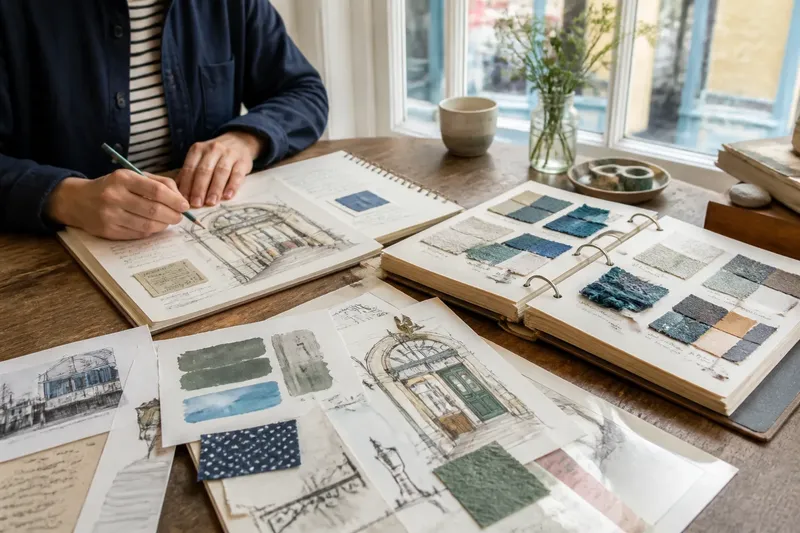
A sketchbook, swatch book or stack of loose sheets will each keep visual references differently, and the right choice depends on what you collect and how you return to it. A maker gathering harbour colours, cloth scraps or shapes seen on a walk needs a system that preserves the useful detail without turning every find into an obligation to file it neatly.
Think of the three as different kinds of memory. A sketchbook preserves sequence, a swatch book makes materials comparable, and loose sheets let references move around. None is inherently more serious; each makes some kinds of looking easier and others less convenient.
What does a sketchbook remember well?
A sketchbook is strongest when the order of discovery matters. A drawn doorway beside a note about its worn blue paint, followed by a quick study of the shadows at the threshold, keeps a chain of attention intact. The pages can hold observations that would be hard to understand if separated: a shape, the place it came from and the thought it prompted.
This makes a bound book a natural companion for regular drawing, field notes and visual research that develops over time. It also suits small, flat additions such as a ticket, paper label or leaf rubbing, provided the binding can accommodate them without forcing the pages to bulge. A book with paper that takes pencil, coloured pencil or light washes gives more freedom than one chosen only for its cover.
The limitation is that sequence can become a filing system by accident. If a maker wants to compare every green sampled from different buildings, those colours may be scattered across many pages. An index at the back, with a few subject words and page references, can help; a complicated contents scheme is rarely worth maintaining for a book used in quick bursts.
There is also a useful distinction between recording and collecting. A sketchbook does not need to contain a specimen of every material that catches the eye. A drawing with a note such as “rough, chalky surface” may preserve the observation better than attaching a crumbly fragment that sheds into the binding.
When is a swatch book the better fit?
A swatch book is designed for comparison. Fabric, yarn, paper, leather offcuts and paint samples are easier to assess when similar pieces sit together, labelled with whatever matters to the maker: fibre, finish, source, colour name or intended use. That arrangement can reveal differences in texture and tone that are easily missed when samples are kept in separate envelopes.
Choose the format around the material rather than the romance of a tidy grid. A ring binder or screw-post book lets thick samples turn without crowding; stitched or glued pages can suit flatter papers and small textile pieces. If the samples vary in weight or thickness, leave room for the collection to grow and make sure labels remain visible when the pages lie open.
Swatch books are less suited to references whose meaning depends on where they appeared. A strip of woven cloth may be useful on its own, but a note that it came from a market stall awning, beside a sketch of the surrounding street, can change what the sample suggests. Add a small source note or a thumbnail drawing rather than expecting the material to speak for itself later.
Be selective about what gets attached. A sample should be large enough to show the property being compared, but not so large that turning the page becomes awkward. Tiny fragments can work for colour or weave; a full-size piece may be necessary when drape or scale is the point. The useful size is the one that preserves the quality you intend to judge.
Why keep references on loose sheets?
Loose sheets suit a changing body of work. A maker can sort a pencil study of a local shopfront beside a paper sample, pin both near a cutting table, then return them to a folder when the project moves on. This mobility is especially helpful when references need to be seen together, rearranged or shared with a collaborator.
Use sheets that can bear the marks they are likely to receive. Heavier drawing paper takes handling better than delicate notebook paper; tracing paper is useful for overlays but can crease and tear; card supports small mounted fragments. Store dissimilar materials in separate sleeves if one could stain, shed fibres or press texture into another.
The trade-off is that loose references can lose their context. A sheet with an unlabeled colour patch may look self-explanatory today and mysterious after a season away from the project. Write the source and a few identifying words directly on the sheet or on an attached tab. A date can help when the sequence matters, but not every scrap needs a diary entry.
Say you collect shapes and colours from the covered arcade in your county town while developing a set of printed cards. You might draw the repeated roof supports in a sketchbook, keep paper and ink samples together in a swatch book, and place several loose studies on a board to decide which composition feels balanced. The expected observable result is different in each case: a readable sequence of looking, a direct material comparison and a temporary arrangement you can alter without redrawing it.
How should you choose between the three?
Start with the material that appears most often in your work, then consider what you need to do with it later. If the reference is mainly an observation, a sketchbook keeps it in a useful sequence. If it is a material to compare by touch, colour or finish, a swatch book gives it company. If it needs to move between a desk, wall and folder, loose sheets are more accommodating.
- Choose a sketchbook for drawings, written observations and references whose order tells part of the story.
- Choose a swatch book for repeat comparisons among fabric, paper, yarn, finishes or other physical samples.
- Choose loose sheets when you want to group, pin up, rearrange or lend references during a project.
- Combine formats when one material serves different purposes: record the place in a book, keep the specimen in a swatch book and move working studies as loose sheets.
There is no need to force every reference into one container. A working system can be deliberately modest: one book for looking, one folder for active sheets and a swatch binder for materials you actually compare. The point is not to make a complete archive of every surface encountered on a walk through a town or along a canal path.
Which format answers your working questions?
Can a sketchbook hold fabric samples?
It can hold small, light pieces if the pages and binding can accommodate them. For thicker or numerous samples, a binder or separate swatch book is easier to handle and less likely to distort the drawings around them.
How do I stop loose sheets from getting muddled?
Keep active references in a labelled folder or sleeve, with a short source note on each sheet. Separate finished project material from current studies so a useful drawing does not disappear among unrelated scraps.
Should swatches be arranged by colour or by material?
Arrange them by the comparison you make most often. Grouping by fibre or surface helps when choosing a material; arranging by colour helps when coordinating a palette, and simple dividers can keep both routes legible.
Is one format enough for a small practice?
Often, yes, if it suits the work being done now. A sketchbook with a folder tucked nearby may be more useful than buying several formats before there are enough references to justify them.
What is worth maintaining?
Keep the system easy to revisit. A readable label, a source note and a sensible home for active material do more than elaborate numbering or decorative tabs that take longer to update than the references take to collect. When a page or sample stops being useful, it can be moved, copied or discarded without treating the container as a permanent record of every decision.
For a maker deciding between sketchbook, swatch book and loose sheets, the most revealing question is not which format looks most finished on a shelf. It is what you want to notice when you return to the material: the path of an idea, the difference between samples or the way separate references change when placed beside one another.